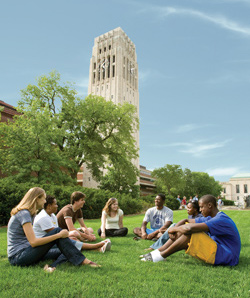
UM success starts here!
We have identified some helpful resources on campus for University of Michigan students with dyslexia and learning disabilities. These organizations and offices can help make your U-M experience a successful one!
The Knox Center
If you’re ever in need of adaptive technology or high-tech tools for your computing needs, the Knox Center has all the resources.
Located in the Shapiro Undergraduate Library on Central Campus, the James Edward Knox Center Adaptive Technology Computing Site (ATCS) is home to a bevy of computing equipment and software for those with temporary and permanent disabilities. The Center includes nine different workstations with adjustable workstations in the Shapiro Library, and is open for most of the Shapiro Library hours.
Office of Institutional Equity
The Office of Institutional Equity has expertise with many types of discrimination, including those sometimes experienced by people with disabilities when they are targets of discrimination, exclusion, or unfair treatment.
Office of the Student Ombudsmen
The Office of the Student Ombudsmen is a place where student questions, complaints and concerns about the functioning of the University can be discussed confidentially in a safe environment. The office promotes positive organizational change by facilitating improvements in University policies, procedures, services, and systems to better serve students.
U-M Council for Disability Concerns (CFDC)
The U-M Council for Disability Concerns (CFDC) meets monthly to address disability issues affecting the University of Michigan community. Members represent a broad cross-section of the University and surrounding area. The Council is organized in committees reflecting the concerns and interests of its members including: Construction Advisory Committee, Investing in Ability Week (IAW) Speakers Committee, and the Neubacher Award Committee. Meetings are open to all members of the University community.
U-M Initiative on Disability Studies
The U-M Initiative on Disability Studies is an interdisciplinary program that seeks to expand diversity at the University of Michigan by integrating the study of disability into research, scholarship, and teaching. UMInDS understands disability as a critical concept necessary to the advancement of the natural and social sciences, the humanities, and the arts. Some of UMInDS’s activities include the graduate seminar “Topics in Disability Studies”, the annual Michael Erik Myatt Distinguished Dissertation Award in Disability Studies, Mini-Grant opportunities for research in disability studies, and a summer internship for graduate students at the United Nations.
U-M Services for Students with Disabilities (SSD)
The U-M Services for Students with Disabilities (SSD) office exists as a student advocacy agency. They can assist with obtaining appropriate accommodations and resolving disputes with faculty about access and reasonable accommodation. Registered students are assigned a Coordinator of Services to assist them as they arrange for services and serve as an advocate if there are accommodation issues.
Students must take steps to identify themselves as having a disability, as necessary, in communications with instructors. They also must accept responsibilities involved in the academic process.
You may use the SSD website to:
- Browse helpful resources and technology information
- See what academic accommodations are available for registered students
- Find information on funding and financial assistance
- Learn what your rights and responsibilities are
SSD also offers a book scanning service. For more information, contact Dan Measel at longcane@umich.edu.
General Information
Find a current list of U-M Ann Arbor Campus accessibility information, including transportation, campus maps, athletic events, adaptive technology, and much more.